
Screen-Free Activities for Kids: 30 Ideas When You Need Them to Play (Not Watch)
Real activities for ages 2-8 that buy you 30 minutes of independent play — using stuff you already have.
Gizella Nagyne Palinkas
4/28/20267 min read
I've been there — it's 4pm, dinner isn't started, and the iPad is already on its third hour. No judgment. But if you want a go-to list of screen-free activities your kids will actually do, I've done the testing for you.
Why Screen-Free Play Actually Matters
If you've ever handed a device to a child and watched them go completely still — eyes glazed, totally unreachable — you already know on a gut level that something is happening to their brain. And science backs that feeling up. Research out of the NIH's landmark Adolescent Brain Cognitive Development (ABCD) Study found that children who spend more than two hours per day on screens score significantly lower on cognitive and developmental assessments than children with minimal screen exposure. We're talking measurable differences in attention span, creative problem-solving, and social skills — not just theoretical concerns from hand-wringing pediatricians.
The mechanism isn't mysterious. Screens, especially fast-paced video content and interactive apps, deliver a constant stream of novelty and stimulation. The brain gets accustomed to that level of input. When screen time ends, real life — which moves slower, requires more effort, and offers less immediate reward — feels profoundly boring by comparison. This is why a child who just watched two hours of cartoons can stand in the middle of a room full of toys and declare there is "nothing to do." Their threshold for engagement has been temporarily raised. Screen-free play, on the other hand, builds the mental muscles that actually matter for long-term success: executive function, emotional regulation, the ability to sit with discomfort and push through it.
Social development also takes a meaningful hit when screens crowd out face-to-face play. Children learn empathy, negotiation, turn-taking, and conflict resolution through play with other people — not through content consumption. Language development, too, thrives on conversation and storytelling, not passive viewing. Even physical coordination, which sounds unrelated, benefits enormously from unstructured outdoor play that engages proprioception, balance, and fine motor skills in ways that no screen-based game can replicate. The good news: the research also shows that children's brains are remarkably plastic. Pulling back on screens and adding quality play time produces measurable improvements relatively quickly — often within weeks.
The Boredom Science Nobody Talks About
Here's something that sounds counterintuitive but is thoroughly supported by research: boredom is genuinely good for children. When we rush to fill every quiet moment with stimulation — screens, organized activities, background TV — we rob kids of the mental space where creativity is born. Dr. Stuart Brown, founder of the National Institute for Play, has documented for decades how unstructured "free time" where children must invent their own entertainment is the single most powerful driver of imaginative development. The discomfort of boredom is actually the beginning of creative thinking. A child who sits with "I don't know what to do" for ten minutes and then figures it out has just done something cognitively remarkable — they've generated their own motivation, which is the precursor to every form of self-directed learning.
A 2015 study published in Pediatrics by Radesky et al. specifically examined how overstimulation and lack of free play correlates with reduced self-regulation in young children. The researchers found that children who regularly experienced boredom and had to navigate it independently showed stronger executive function by age seven. In practical terms: let them be bored. Resist the impulse to immediately fix it. Give it ten minutes. You may be surprised by what they invent.
4–6 hrs
Children ages 8–12 spend an average of 4–6 hours per day on screens — double what pediatricians recommend. Common Sense Media's 2023 Census puts the figure even higher for tweens approaching middle school age.
30 Screen-Free Activities, Organized by Age
The activities below aren't pulled from a theoretical list — they're the ones that have actually worked in real households, with real kids who know how to protest. I've organized them by age group because what captivates a toddler and what keeps a second-grader engaged are genuinely different things. Start with the age group that matches your child, but don't feel locked in — a six-year-old might love a sensory bin that's technically "for toddlers," and a curious three-year-old might surprise you with the preschool projects.
1
Toddlers (Ages 1–3): Sensory & Hands-On Play
At this age, play is about exploration. Every texture, sound, and movement is new information. These activities are low-setup, high-engagement, and built around what toddler brains love most: repetition and discovery.
Sensory bin with dry rice or dried beans, cups, and spoons — pour, fill, and dump is endlessly fascinating
Water play in a plastic bin with sponges, small cups, and rubber bath toys (outside or in the tub)
Finger painting with washable paints on large butcher paper taped to the floor
Stacking and knocking over towers of soft blocks or plastic cups
Simple shape sorter or wooden puzzle with chunky, easy-grip pieces
Playdough with cookie cutters, rolling pins, and plastic utensils
Treasure basket exploration — fill a basket with safe household items of different textures and sizes
Walking barefoot in grass or sand and describing what it feels like together
Blowing bubbles in the backyard or on the balcony
Simple board books read aloud with lots of pointing, naming, and sound effects — language building disguised as cuddling
2
Preschoolers (Ages 3–5): Creative & Imaginative Play
Preschoolers are entering the golden age of pretend play. Their brains are wiring up narrative thinking and social cognition simultaneously. These activities feed both — and most require only materials you already have at home.
Dress-up box with old clothes, scarves, hats, and costume jewelry for open-ended pretend play
Play kitchen or play restaurant — set up a "menu," take orders, and serve stuffed animals as customers
Blanket fort building with sofa cushions, chairs, and bed sheets
Simple nature scavenger hunt — make a picture list of things to find (leaf, rock, feather, stick, flower)
Coloring books paired with dot markers or watercolor crayons for easy, low-mess color play
Magnetic tile building (Magna-Tiles or similar) — preschoolers can build for 30+ minutes independently
Puppet show with sock puppets or paper bag puppets and a "stage" made from a box
Simple baking — measuring and mixing muffin batter or cookie dough with you teaches math through play
Sidewalk chalk murals and obstacle courses drawn on the driveway
Animal sorting, matching, and small-world play with plastic animals in a tray of grass or sand
3
School-Age (Ages 6–10): Skill-Building & Challenge Play
School-age kids crave accomplishment. They want to make things, master skills, and show what they can do. The key at this age is providing activities with enough complexity to feel genuinely challenging — but achievable. Boredom hits fast when things feel too easy.
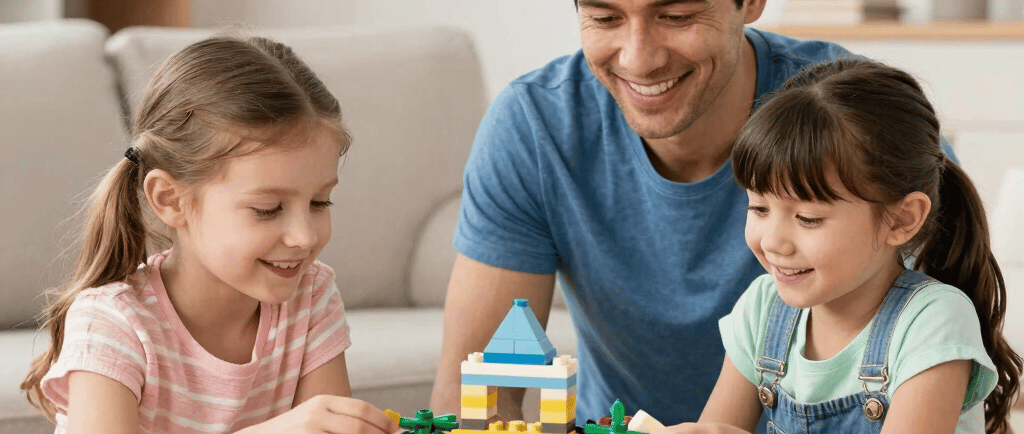
LEGO free-building time without instructions — ask them to build something from their imagination, not the box
Start a comic strip or graphic novel using blank paper and markers — no artistic ability required, just storytelling
Card games: Uno, Go Fish, Rummy, War, or more complex games like Sushi Go for older kids
Science experiments at home — baking soda and vinegar volcano, growing crystals with salt water, paper towel chromatography
Jigsaw puzzles — keep a 100–300 piece puzzle on the coffee table as an ongoing project
Learn a new skill together: origami, knitting finger loops, basic embroidery, or beginner chess
Outdoor obstacle course with items from the garage — hula hoops, cones, jump rope, and chalk lines
Journaling or diary writing with a dedicated notebook and colored pens — prompt them with a question to start
Board games with strategy: Sequence for Kids, Blokus, Battleship, or Ticket to Ride: First Journey
Backyard gardening — give them their own small patch or pot to plant, water, and observe over time
When You Need Something Right NOW: The 5-Minute Setup Activities
Not every day allows for elaborate activity setups. Sometimes dinner is burning, the baby is crying, and you need something that works in sixty seconds. These six activities require almost zero preparation and have a proven track record of actually holding kids' attention — not just in theory, but in the chaos of real family life.
🧺
The Mystery Bin
Grab a laundry basket and fill it with 10 random safe household items — a wooden spoon, a small pot, a measuring cup, a sponge. No instructions, no objective. Watch what they invent. Toddlers through age 6 will explore independently for 20+ minutes.
📦
A Cardboard Box
An empty Amazon box and a set of markers. That's it. Kids turn boxes into rockets, houses, cars, and treasure chests. Keep a "big box" in the garage for these moments. It costs nothing and works every single time.
🎲
Dice Story Game
Grab two dice and a piece of paper. Roll the dice — each number equals a character or story element you've agreed on together. Kids take turns rolling and adding to the story. Works from age 5 up and builds narrative thinking effortlessly.
🪣
Backyard Water Play
Fill a plastic tub or bucket with water, add a few plastic cups and containers, and point them outside. Add food coloring for extra excitement. Works year-round with appropriate clothing. Setup time: 90 seconds. Time it buys you: 30–45 minutes.
🗺️
Indoor Treasure Hunt
Quickly hide 5 small objects around the living room and draw a basic picture map on a notepad. Hand it over with a small "treasure" at the end (a sticker, a snack, a piece of gum). Kids will run the route multiple times after you've set it up once.
🖊️
Drawing Challenges
Write 10 drawing prompts on slips of paper, fold them, and put them in a bowl. Kids draw a prompt, then you guess. Prompts like "a dinosaur eating pizza" or "our dog as a superhero" get specific enough to spark imagination without overwhelming choice.
How to Actually Make Screen-Free Time Stick
Every parent has tried the "no screens today" declaration that lasted until about 10am. Making screen-free time a real, durable part of your family's rhythm requires more than willpower — it requires structure. The families who make it work consistently have done two things: they've made screen-free time predictable, and they've made it easy. Predictability means your child knows that after school there is always thirty minutes outside before anything else, or that weekend mornings before 9am are screen-free. Predictability removes the negotiation because the expectation is simply established. Children thrive on routine in a way that adults often underestimate.
The "easy" piece is about reducing friction for the screen-free alternative. If the craft supplies are locked in a closet or the puzzle is missing eight pieces, the screen will win every time. Keep a rotating "activity basket" accessible at kid height — swap it out weekly with different options: a new puzzle, a set of Wikki Stix, a pack of stickers, a simple card game. When the alternative is as easy to access as the remote, kids will naturally reach for it more often. It also helps to designate specific screen-free zones or times that are non-negotiable — meals, the first hour after school, Sunday mornings — rather than trying to monitor and limit all screen time continuously, which is exhausting for everyone.
Finally, the most powerful thing you can do is model the behavior you want to see. Children are deeply attuned to what their parents actually do, not just what they say. If they see you putting your phone down to read a book, draw something, or work in the garden, screen-free time becomes normalized as an adult behavior too — not just a rule imposed on kids. You don't have to be perfect about it. But being intentional about your own screen habits, and letting your kids see that intentionality, is the most persuasive argument for screen-free play that exists.
Stay
Join our newsletter for parenting tips
Contact
Connect
hello@happyparentstoday.com
Copyright © 2026 Happy Parents Today. All rights reserved.