
Picky Eaters: What the Research Says (And What to Stop Doing)
Picky eater? Why pressure backfires, how Ellyn Satter's division of responsibility works, and 7 research-backed strategies that help kids try new foods.
Gizella Nagyne Palinkas
5/15/20269 min read
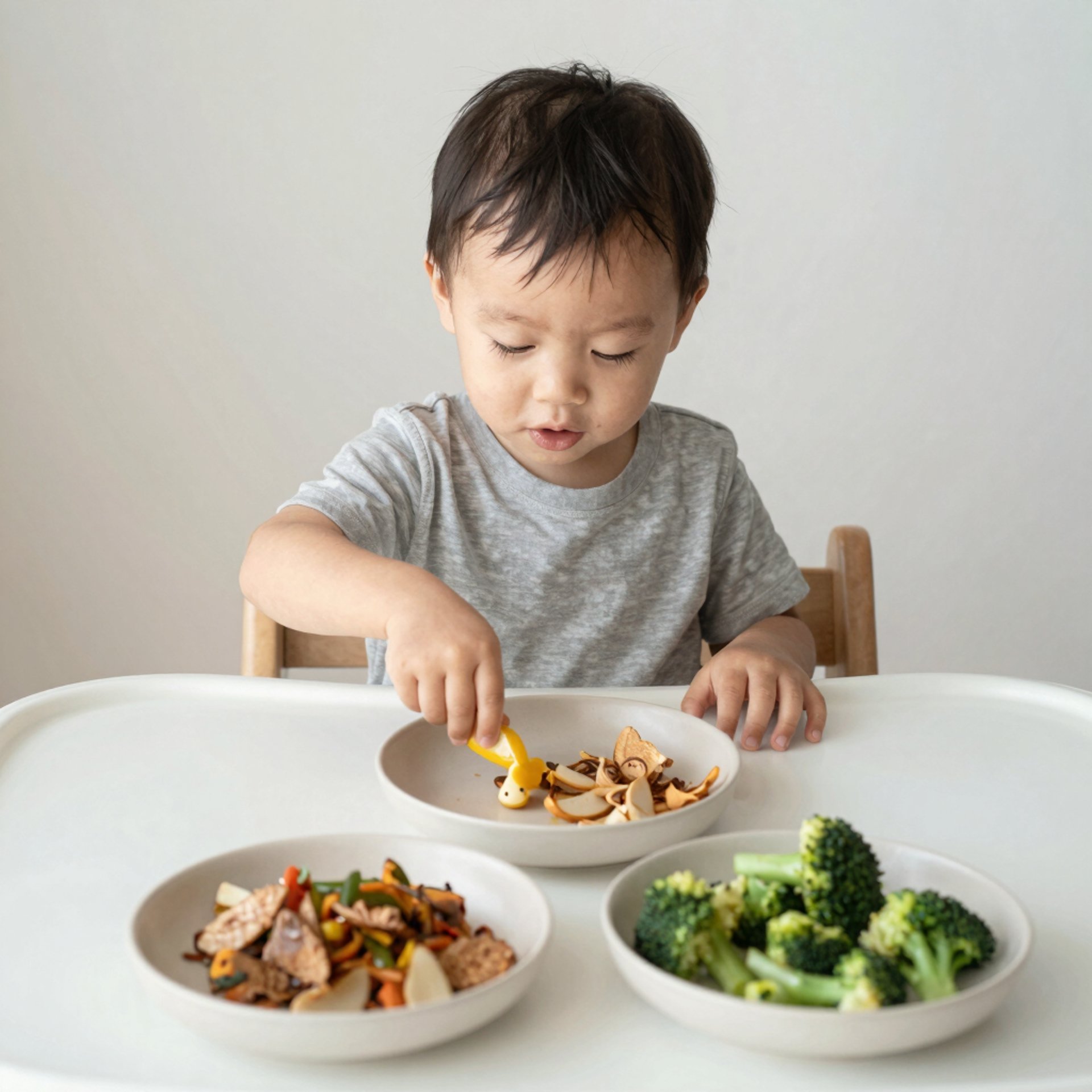
If you've ever watched your toddler push a perfectly good piece of broccoli to the edge of the plate like it personally offended them, you are not alone. Picky eating is one of the most common — and most stressful — challenges parents of young children face. The good news: science has a lot to say about what's actually happening, why our most instinctive responses tend to make things worse, and what genuinely helps. This article unpacks all of it.
Your Child Isn't Being Difficult — They're Being Human
Let's start with the biology, because it reframes everything. What we call "picky eating" in toddlers and preschoolers is largely an expression of food neophobia — a fear or wariness of unfamiliar foods. Far from being a personality flaw or a parenting failure, food neophobia appears to be an evolved survival mechanism. In a world before food safety regulations, toddling children who were cautious about putting unknown things in their mouths were at a survival advantage.
This is why picky eating tends to spike right around age two to three — precisely when children become mobile enough to explore but still lack the cognitive ability to fully assess what's safe. Their gut instinct is: I don't recognize this, so I won't eat it. The developmental arc is predictable: neophobia rises sharply through toddlerhood, peaks around age three, then slowly and naturally declines through middle childhood.
Research from the journal Appetite consistently finds that food neophobia has a meaningful heritable component — twin studies estimate heritability between 46% and 78%. So if you were a picky eater yourself, there's a real biological thread connecting your child's behavior to yours. That said, genetics do not determine destiny. The environment you create at the table is a powerful shaping force, and this is where parents have genuine leverage.
Why the Pressure Approach Backfires
When a child refuses to eat something, the parental instinct is completely understandable: we worry about nutrition, we spent time preparing the food, and we don't want to raise a child who only eats beige foods forever. So we push. We bribe. We cajole. We try the airplane spoon. We say "just one bite." We threaten no dessert. We announce that there's nothing else in the kitchen.
Here's the problem: research consistently shows that pressuring children to eat backfires. Studies tracking children over time find that coercive feeding practices are associated with increased pickiness, not less — and with a diminished ability to self-regulate hunger and fullness cues. When eating becomes a battleground of wills, children dig in. The food that was forced upon them becomes the food they most want to avoid.
A landmark 2001 study by Leann Birch and colleagues at Penn State demonstrated that children who were pressured to eat certain foods rated those foods as less palatable afterward than children who were simply offered them without comment. The act of pressure made the food less appealing. Other studies have replicated this finding across different age groups and food types: the more we push, the more they resist.
Bribing also backfires in its own way. When you say "eat your peas and you can have dessert," you inadvertently elevate the status of dessert (it becomes the reward, the thing worth wanting) and lower the status of peas (they become the obstacle, the thing to be endured). Research on reward-based feeding finds that this type of contingent feeding consistently undermines long-term food preference development.
50%of children aged 3 show significant food neophobia — making it one of the most common developmental phases in early childhood.
The Framework That Changes Everything: Ellyn Satter's Division of Responsibility
If there is one concept that has the most evidence behind it and the most practical impact at the family dinner table, it is registered dietitian and family therapist Ellyn Satter's Division of Responsibility in Feeding (sDOR). Satter spent decades researching how the feeding relationship between parent and child shapes eating behavior, and her model has been validated by research and adopted by major nutrition organizations worldwide.
The framework is elegantly simple: parents are responsible for the what, when, and where of feeding. Children are responsible for whether they eat and how much.
What this means in practice: you decide what foods are on the table, when mealtimes happen, and what the environment looks like. You serve a variety of foods, including at least one thing your child typically accepts. And then — this is the hard part — you let go. You don't track how many bites they take. You don't comment on what they're eating or skipping. You don't prepare a separate "safe" meal if they reject yours. You trust that if you do your job (provide a balanced, structured, pleasant feeding environment), your child will do their job (eat what their body needs over time).
This can feel deeply counterintuitive, especially for parents of picky eaters who are genuinely worried about nutrition. But Satter's research and clinical work shows that children who are raised in a Division of Responsibility environment tend to eat a wider variety of foods over time, maintain healthier relationships with hunger and fullness, and experience far fewer mealtime battles. The parent stops being the food police, and the child stops needing to fight for autonomy. Everyone relaxes.
7 Evidence-Based Strategies That Actually Work
1. Repeated Neutral Exposure
The most robust finding in pediatric feeding research is this: repeated exposure to a food, without pressure, increases acceptance. Studies show it can take anywhere from 8 to 15 exposures before a child accepts a new food — sometimes more. The exposure doesn't require eating. Seeing the food on the plate, touching it, smelling it — all of it counts as exposure. The rule is: keep offering, keep it low-key, and don't count the attempts out loud.
2. Family-Style Serving
Research supports serving food family-style — placing dishes in the center of the table and letting everyone (including children) serve themselves — over pre-plating individual portions. Children who have some control over how much food lands on their plate show greater willingness to try new items and report less mealtime anxiety. Choice, even small choice, reduces resistance.
3. Involve Children in Cooking and Shopping
Studies consistently find that children who participate in food preparation and grocery shopping are significantly more likely to try and accept new foods. This effect holds even for very young children. You don't need elaborate cooking projects — washing vegetables, tearing lettuce, stirring batter, choosing between two vegetables at the store. The investment of labor creates investment in the outcome.
4. Eat Together, and Eat the Same Things
Children are powerful imitators. Social learning plays a significant role in food acceptance: children observe what adults and peers eat and use those observations as cues about what is safe and desirable. Eating together as a family, modeling enjoyment of a variety of foods, and not making a production of it is one of the simplest and most effective things you can do. Research on peer modeling shows that even watching other children eat a new food significantly increases the likelihood of a picky eater trying it.
5. Keep the Environment Low-Pressure and Predictable
Mealtime stress is contagious. When parents are visibly anxious about what their child will or won't eat, children pick up on that energy and the stakes feel higher. Regular, structured mealtimes at roughly the same time each day, with minimal distraction and a calm atmosphere, create the conditions under which food exploration is most likely to happen. Hunger is a great motivator — but only when it's allowed to build between structured meals and snacks.
6. Bridge Foods and Food Chaining
Food chaining is a clinical technique used by feeding therapists: rather than asking a child to leap from mac and cheese to roasted salmon, you take tiny steps. If a child accepts potato chips, you might introduce baked potato wedges. From there, maybe roasted sweet potato. The technique meets children exactly where they are and uses the sensory properties they already accept (texture, temperature, flavor profile) as bridges to new foods. You don't need a therapist to apply the basic principle at home.
7. Stop Making Separate "Kid Meals"
It feels kind to make your child something you know they'll eat. In the moment, it reduces conflict. But over time, maintaining a separate kids' menu signals that the "real" food at the table isn't for your child, and it removes the exposure opportunities that drive long-term acceptance. Satter's model recommends always including one accepted food in every meal, but serving it alongside the same foods the rest of the family eats — without fanfare, without coercion, and without a separate plate of nuggets as backup.
When Is It More Than Just Picky Eating?
Most of the time, picky eating is a developmentally normal phase — frustrating, yes, but not medically concerning. However, it's important for parents to know when the picture has shifted into something that warrants professional attention.
Avoidant/Restrictive Food Intake Disorder (ARFID) is a clinical diagnosis that describes food restriction severe enough to cause nutritional deficiency, significant weight loss (or failure to gain weight as expected), reliance on nutritional supplements to maintain health, or marked interference with psychosocial functioning. Children with ARFID may eat as few as five to fifteen foods total, may experience extreme anxiety or even gagging at the sight or smell of certain foods, and do not grow out of the pattern the way typical picky eaters do.
The distinction matters because ARFID requires professional intervention — typically a team approach involving a feeding therapist, dietitian, and sometimes a psychologist. It does not respond to the strategies in this article in the way typical picky eating does. If your child is losing weight, dropping significant percentiles on their growth chart, refusing all proteins or all vegetables or all textures to a clinically concerning degree, or showing extreme distress around food, please bring it to your pediatrician's attention rather than waiting it out.
For the vast majority of parents reading this, however, the picture is one of normal developmental pickiness that is very responsive to a low-pressure, exposure-rich, patient feeding environment.
The Long Game: What "Success" Actually Looks Like
One of the most liberating things research tells us is that food acceptance in children is not measured in weeks — it's measured in months and years. The arc bends toward improvement. As food neophobia naturally declines through middle childhood, children who have been raised in low-pressure feeding environments tend to expand their palates steadily, not dramatically or overnight.
Success doesn't look like a toddler who eats everything you put in front of them. Success looks like a child who is comfortable at the table, who can tolerate unfamiliar foods being present without a meltdown, who occasionally surprises you by taking a bite of something new, and who — over years — becomes a progressively more adventurous eater. That is a realistic, research-supported trajectory, and it is entirely achievable without turning every dinner into a negotiation.
So take a breath. Stop counting bites. Keep offering. And trust the process.
Frequently Asked Questions
How many times should I offer a new food before giving up?
Research suggests offering a new food at least 10–15 times before drawing conclusions about a child's preference. Studies published in the journal Appetite show that repeated neutral exposure — without pressure — is the single most reliable way to increase acceptance. The key word is "neutral": placing the food on the plate without comment or coercion. Many parents give up after 2–3 tries, which is far too early. The exposures don't even require eating — a child touching, smelling, or licking a food counts as meaningful contact that builds familiarity over time.
Is picky eating genetic?
Partly, yes. Twin studies suggest that food neophobia (fear of new foods) has a heritable component — estimates range from 46% to 78%. But genetics are not destiny. Environment, feeding practices, and consistent exposure powerfully shape whether innate wariness translates into lasting pickiness. So even if your child inherited a cautious palate, your approach at the table matters enormously. The research shows that supportive, low-pressure feeding environments reduce the behavioral expression of genetically influenced food neophobia significantly.
What is the Division of Responsibility model?
Ellyn Satter's Division of Responsibility (DOR) is a feeding framework that divides mealtime roles clearly: parents decide what food is served, when it is served, and where meals happen. Children decide whether to eat and how much. This boundary reduces power struggles, preserves the child's autonomy, and allows hunger and appetite to work as they're designed to. Satter's research-backed model is endorsed by major dietetic and pediatric organizations worldwide, and decades of clinical work support its effectiveness in reducing picky eating and improving mealtime relationships.
How is ARFID different from picky eating?
Avoidant/Restrictive Food Intake Disorder (ARFID) is a clinical diagnosis involving food restriction severe enough to cause nutritional deficiency, significant weight loss, dependence on supplements, or marked interference with daily functioning. Unlike typical picky eating — which is developmentally normal and usually improves with age — ARFID does not resolve on its own and requires professional intervention. If your child is losing weight, refusing entire food groups to a degree that affects health, or showing extreme anxiety around food, talk to your pediatrician. A feeding therapist and registered dietitian are typically part of the treatment team for ARFID.
Should I hide vegetables in food?
The research is not encouraging on this strategy. While hiding vegetables may boost nutritional intake in the short term, it does nothing to build actual acceptance of those foods — and it bypasses the repeated exposure that is essential for long-term preference change. Some studies suggest that children who discover hidden ingredients feel deceived, which can erode mealtime trust. A better approach: serve vegetables openly, repeatedly, without pressure, and let familiarity do its slow, steady work. If you do add pureed vegetables to sauces or muffins, do it in addition to — not instead of — serving those vegetables in recognizable form.
When does picky eating usually get better on its own?
For most children, picky eating peaks around age 3 and gradually improves through ages 5–8 as food neophobia naturally declines. Research tracking children longitudinally shows that by age 8, the prevalence of significant pickiness drops to around 15% — less than half of what it was at the peak toddler years. Patience, consistent exposure, and low-pressure mealtimes are the best catalysts for this natural improvement. Children raised in high-pressure feeding environments tend to show a slower trajectory of improvement, which is one of the strongest arguments for backing off and letting the biology take its course.
Stay
Join our newsletter for parenting tips
Contact
Connect
hello@happyparentstoday.com
Copyright © 2026 Happy Parents Today. All rights reserved.