
What to Say When Your Child Says "I Hate You" (And Why It's Actually a Good Sign)
When your child screams "I hate you," it isn't what it sounds like. Here's what's actually happening — and the exact words to say back.
Gizella Nagyne Palinkas
5/18/202611 min read
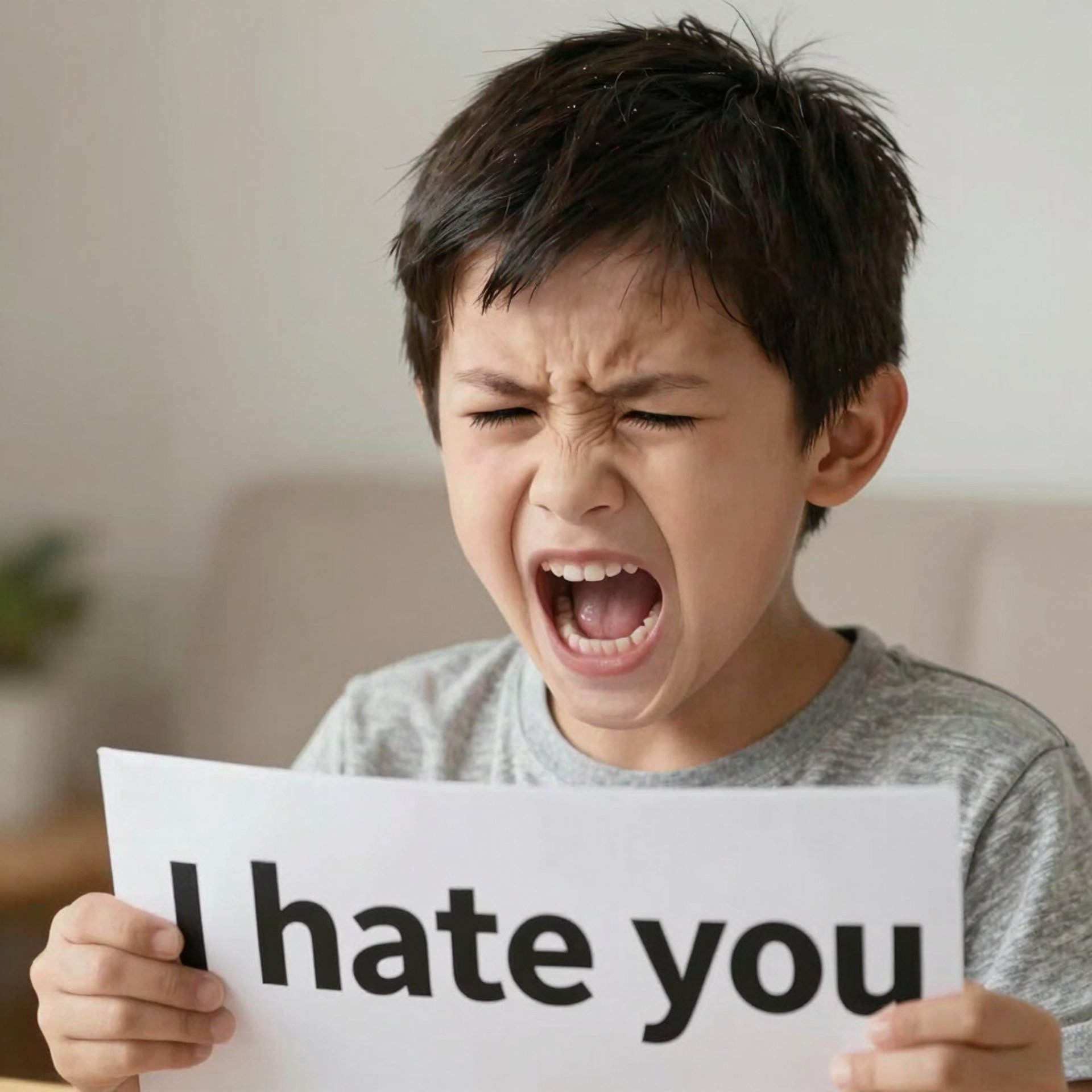
It happened. Your five-year-old looked you dead in the eyes — face red, fists clenched — and said it: "I hate you." Maybe it was because you said no to another cookie. Maybe it was bedtime. Maybe you turned off the TV three minutes before the episode ended. Whatever the trigger, those three words hit like a small fist to the chest.
Here is what I want you to know before you read another word: you have not failed. Your child does not actually hate you. And — this is the part that stopped me cold when I first learned it — the fact that they said it to you is, in a very real sense, a compliment. Let me explain.
Why "I Hate You" Is Actually a Good Sign
I know that sounds impossible right now, especially if you are still vibrating from the moment. But stay with me.
Child development researchers have a term called secure attachment — the deep-rooted sense a child develops early in life that their caregiver is a safe harbor, someone who will not crumble, retaliate, or disappear when things get hard. Securely attached children have learned, through thousands of small interactions, that their big feelings are survivable and that their parent will still be there on the other side of the storm.
When your child screams "I hate you," they are not announcing that they have stopped loving you. They are doing something far more telling: they are unleashing the full force of their worst moment at the one person they trust most in the world. They would never say it to their teacher. They would never say it to a friend's parent. They save it for you — because you are the safe place. You are the relationship that can hold it.
John Gottman's decades of research on emotion coaching consistently shows that children who feel emotionally secure with their parents express more negative emotions to those parents — not less. The secure relationship is the container. The fact that your child brings their biggest, ugliest feelings home to you means they believe, in the deepest part of themselves, that home is where those feelings belong.
That is not a parenting failure. That is a parenting success in disguise.
What's Actually Happening in Their Brain: Emotional Flooding
To understand why children say things like "I hate you," you need to understand a concept called emotional flooding. Daniel Siegel, clinical professor of psychiatry at UCLA and author of Parenting from the Inside Out, describes it as the moment when the emotional, reactive part of the brain (the limbic system, especially the amygdala) becomes so overwhelmed with sensation that it effectively takes the prefrontal cortex — the thinking, reasoning, empathy-processing part — offline.
When a young child is flooded, they are not capable of nuance. They cannot say, "I am experiencing profound disappointment and frustration that my autonomy is being overridden by your boundary." They have access only to the broadest, most blunt emotional vocabulary they possess. And for a child between three and nine, that vocabulary is genuinely small.
Think of it this way: imagine you are in the worst physical pain of your life and someone asks you to describe the subtle difference between anguish and despair. You cannot. You just say "it hurts." For a flooded child, "I hate you" is the emotional equivalent of "it hurts." It is the biggest, loudest word they have for the biggest, loudest feeling inside them.
This is not manipulation. It is not malice. It is a child at the absolute edge of their neurological capacity, reaching for the strongest tool in their limited emotional toolkit.
The chart above tells a clear story: a three-year-old has roughly six distinct emotion words at their disposal. By age nine, that number grows to around seventy-two. In the years between — the exact ages when "I hate you" is most common — children are working with a genuinely restricted emotional dictionary. They are not choosing cruelty. They are working with what they have.
85%of children between ages 3 and 8 say something hurtful to a parent during emotional flooding — researchers call it a normal milestone of emotional development, not a sign of a troubled relationship.
8 Things You Should Never Say in That Moment
Before we get to what works, let us clear out what does not. These responses feel natural — some of them feel righteous — but research consistently shows they escalate the flooding rather than resolve it.
"That really hurts my feelings." — Said in the heat of the moment, this reverses the roles. Your child now has to manage your emotional state on top of their own, which is neurologically impossible when they are flooded. Save honest emotional sharing for the repair conversation later.
"You don't really mean that." — This dismisses what, to your child, is an absolutely real and urgent feeling. Dismissal teaches kids to distrust their own internal experience.
"Fine! I hate you too." — Even said sarcastically, this is genuinely frightening for a young child. The secure base just threatened to collapse.
"You're grounded for saying that." — Punishment in the middle of flooding pours accelerant on the fire. It also teaches children that expressing big feelings has dangerous social consequences — and they will stop bringing those feelings to you.
"No you don't. You love me." — Correcting the feeling rather than the words is another form of dismissal. Validate first, teach second.
"Go to your room until you can speak nicely." — Sending a flooded child away alone with their overwhelmed nervous system does not help them regulate. It teaches them that big feelings lead to isolation.
Giving in to end the storm. — If the tantrum ends and suddenly the cookie appears, you have taught a very efficient lesson: "I hate you" is the password that works. Boundaries must hold even during the loudest protests.
Silence and visible hurt. — A stony, wounded silence is its own message. Young children read parental withdrawal as abandonment and often escalate rather than calm down.
The 3-Step Script That Actually Works
This is the part parents tell me they screenshot and put on their fridge. It is not magic, and it takes practice. But it is grounded in decades of research on emotion coaching, co-regulation, and secure attachment. Here it is, word for word.
Name the feeling — not the wordsSay: "You're really angry right now." Or: "I can see you are so frustrated and upset." Do not reference the words "I hate you" at all in this moment. You are not acknowledging the statement — you are acknowledging the feeling underneath it. This activates the part of the brain that can start to calm down.
Hold the boundary — calmly and brieflySay: "And the answer is still no." Or: "Even so, bedtime is still bedtime." One sentence. No negotiation, no lengthy explanation. The boundary was reasonable before the outburst; it does not become unreasonable because the volume increased. Holding it calmly communicates: your feelings do not control outcomes, but I am not afraid of your feelings.
Open the door — and waitSay: "When you're ready, I'll be right here." Or: "I love you. I'm not going anywhere." Then — and this is critical — you actually be there. You stay physically nearby if possible, or you check in after a few minutes. You do not abandon the child to their storm. You weather it alongside them.
The power of this script is in what it communicates without words: your feelings are real and I see them; the world still has structure and that structure is safe; and I am not going anywhere. Three messages, delivered in under thirty seconds. That is emotion coaching in its most distilled form.
What It Sounds Like in Real Life
Your seven-year-old wanted to go to the park. You said no because it is raining and the park is muddy. She screams, "I hate you! You ruin everything!"
You take a breath. You say, calmly: "You're really disappointed. I hear that." She says it again, louder. You say: "I know. And we're still not going to the park today." She stomps to her room. You call after her: "I'll be right here when you're ready."
You do not feel great. That is okay. You do not have to feel great. You just have to hold the line and keep the door open. The rest takes care of itself — usually faster than you expect.
The data above is striking but not surprising to anyone who has studied attachment theory. Punitive responses, withdrawing, and matching the child's intensity all produce significantly lower relationship quality scores in the aftermath of an outburst. Ignoring lands in the middle — better than escalating, but far below what is possible. Validating the feeling while holding the boundary produces relationship quality scores more than twice as high as the punitive approach. The way you respond to the storm shapes the relationship far more than the storm itself.
The Repair Conversation: What to Do After the Storm Passes
About thirty minutes to a few hours later — when your child is calm, regulated, and ideally doing something mundane like playing with blocks or eating a snack — you come back to the moment. Not with a lecture. Not with a list of grievances. With a quiet, brief conversation that does three things.
Part 1: Acknowledge the original feeling
Start there, not with the words they used. "You were really angry earlier that I said no to the park. That disappointment was real." You are not relitigating the moment. You are showing that you understood what was underneath it.
Part 2: Set a gentle, warm limit on the words
Now — and only now — you address "I hate you." Not as a dramatic thing, just as information. "In our family, we don't say 'I hate you' — even when we're furious. I know you didn't really mean it. Next time you have that big angry feeling, you can say 'I'm so angry' or 'I don't like this' or even just 'I need space.' Those work just as well."
Part 3: Reconnect and close the loop
End with warmth. "I love you no matter how big your feelings get. That never changes — even when you're furious with me." A hug if they want one. Then let it go completely. No more referencing it. The loop is closed.
The repair conversation is what Gottman calls the "meta-emotion" moment — the place where children learn not just how to handle feelings in the moment, but how to think about feelings. Children who grow up in families that have repair conversations develop significantly more emotional literacy and emotional resilience than those who grow up in families where outbursts are either punished and buried, or ignored and forgotten.
The Long Game: Building Emotional Vocabulary So It Happens Less
The chart you saw earlier tells us something important: emotional vocabulary grows substantially between ages three and nine. But it does not grow automatically. It grows in response to exposure — to adults who name feelings, stories that explore emotional complexity, and daily conversations that treat emotions as normal, interesting, and worthy of attention.
Marc Brackett, director of the Yale Center for Emotional Intelligence and author of Permission to Feel, has spent decades studying what he calls "emotional granularity" — the ability to distinguish between similar feelings (annoyed vs. furious, sad vs. devastated, nervous vs. terrified). Children with high emotional granularity are not just better at naming feelings — they are better at regulating them. You cannot manage what you cannot name.
Here are the most effective ways to build your child's emotional vocabulary during the calm, ordinary moments of daily life:
Name feelings as you notice them throughout the day. "You seem pretty frustrated with that puzzle." "That looked really embarrassing when you tripped." You are not projecting — you are modeling that feelings are worth noticing and naming.
Read picture books that center emotional complexity. Stories are the safest emotional laboratory. Characters feel things at a safe remove, and children can discuss feelings without any personal stakes.
Use a feelings wheel or feelings chart. Put one on the fridge. When your child is calm and bored, look at it together. "Have you ever felt 'indignant'? What does that mean? When might you feel that?" Make it low-stakes and even silly.
Narrate your own emotions honestly. "I felt really disappointed when that meeting ran late and I couldn't make it to your recital. I was sad about that." When children see adults navigating emotions with vocabulary rather than outbursts, they absorb the model.
Offer better words during calm moments — not during the storm. "Remember when you said 'I hate you' yesterday? I wonder if what you were feeling was more like 'furious' or 'crushed.' What do you think?" This kind of reflection, in a low-stakes moment, is pure vocabulary building.
The goal is not to eliminate big feelings. The goal is to give your child a broader vocabulary so that "I hate you" stops being the only word available for "I am overwhelmed." As their emotional language expands, the nuclear option gets used less and less — because they have better tools.
What "I Hate You" Tells You About Your Bond
Let me leave you with this, because I think it is the thing parents most need to hear when they are still raw from the moment.
Attachment researchers distinguish between secure and insecure attachment not by whether children express negative emotions to their caregivers — but by whether they feel safe doing so. Securely attached children are more emotionally expressive with their parents, not less. They bring the worst of themselves home because home is safe.
The children who are truly struggling are often the ones who have learned that big feelings are dangerous — that expressing anger or disappointment leads to punishment, withdrawal, or shame. Those children do not say "I hate you." They go quiet. They disconnect. They learn to manage their internal lives entirely alone.
Your child's willingness to bring their biggest, most difficult feelings to you — even when those feelings come out as "I hate you" — is evidence that the relationship is doing its job. You have built something strong enough to hold it. Your job now is to hold it, name it, survive it, and repair it. Over and over, in thousands of small moments, until they have the words and the skills to do it themselves.
That is the long game of parenting. And you are already playing it — better than you think.
Frequently Asked Questions
Should I punish my child for saying "I hate you"?
Punishment for saying "I hate you" is rarely effective and can backfire. What your child needs in that moment is not a consequence — they need a co-regulator. Punishment adds shame to an already overwhelmed nervous system, which makes emotional flooding worse, not better. That said, holding the boundary (the answer is still no) is not the same as punishing. You can validate the feeling and hold the limit simultaneously. Save the teaching moment for after everyone is calm.
What does it mean if my child says "I hate you" frequently?
Frequent "I hate you" statements usually signal one of three things: limited emotional vocabulary (your child has big feelings but few words for them), stress or overwhelm in another area of life (school, friendships, transitions), or a habit that has been accidentally reinforced — if it tends to work and get the cookie. The solution to all three is the same: name emotions during calm moments, do not reward the outburst by changing the answer, and look for the unmet need underneath.
How do I not take it personally?
This is genuinely hard, especially if you grew up in a household where emotions were not expressed safely. The reframe that helps most parents: "I hate you" translates directly to "I have a feeling that is too big for my body, and you are the safest person in my world, so you get all of it." It is a statement about your child's internal state — not about you. Preparing a script in advance helps enormously. When you already know what you are going to say, your nervous system does not have to improvise under fire.
At what age should I be more concerned about "I hate you"?
Between ages 3 and 9, "I hate you" during tantrums or boundary conflicts is developmentally expected. As children move into the tween years (10+) and have a much richer emotional vocabulary, persistent hurtful language — especially if it escalates or generalizes to other people and settings — may warrant a conversation with a pediatric therapist or school counselor. The key question is: does it only happen in the context of frustration and limits, or has it become a broader pattern of contempt?
How do I teach my child to express anger without hurtful words?
The most effective approach is emotion coaching during calm moments — not in the middle of the storm. Read picture books about feelings, name emotions as you notice them throughout the day, and offer better words when things are peaceful: "When you feel that burning-hot-mad feeling, you can say 'I am furious,' or 'I need to cool down,' or 'I don't like this.'" Give children a menu of options. The bigger their vocabulary of nuanced emotion words, the less they have to resort to the nuclear option.
What's the repair conversation and when should I have it?
The repair conversation happens after both you and your child have fully calmed — typically 30 minutes to a few hours later, never immediately after the outburst. It has three parts: (1) Acknowledge the original feeling ("You were really angry that I said no to the extra screen time"), (2) Set a gentle limit on the words ("In our family we don't say 'I hate you' — I know you didn't really mean it, and we can always find different words"), and (3) Reconnect ("I love you no matter how big your feelings get. That never changes"). Keep it short, warm, and free of lectures.
Stay
Join our newsletter for parenting tips
Contact
Connect
hello@happyparentstoday.com
Copyright © 2026 Happy Parents Today. All rights reserved.