
Why Your Kids Fight (And the Phrase That Stops It in Seconds)
Siblings can go from best friends to mortal enemies in under thirty seconds — and back again before you have even finished sighing. If it feels like your children are professionally trained conflict generators, you are not imagining things. But the reasons behind all that fighting are more understandable than you might think, and the fix is simpler than any parenting book has ever made it sound.
Gizella Nagyne Palinkas
5/25/20268 min read
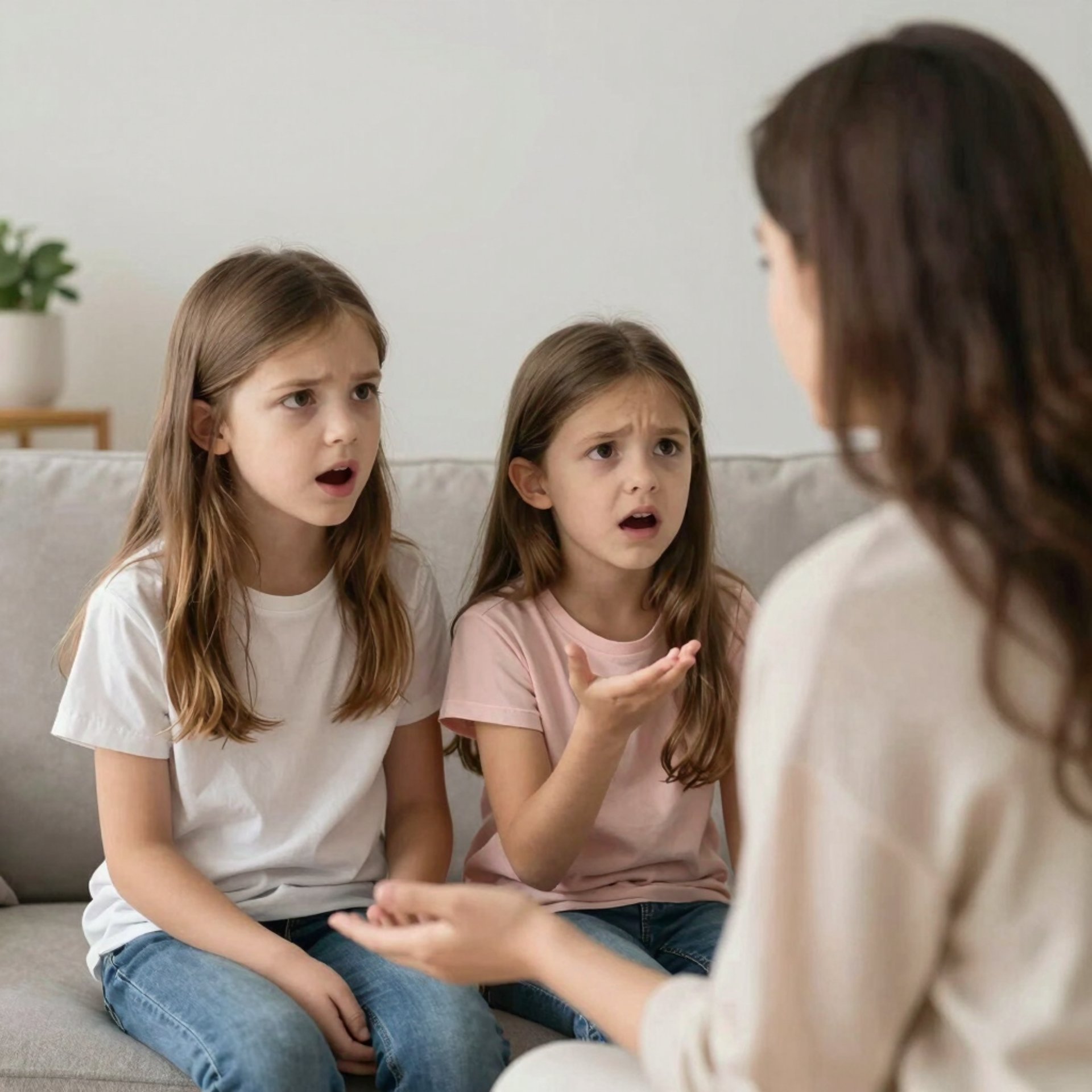
It was a Tuesday afternoon. My two kids had been playing happily for nearly twenty minutes — long enough for me to feel genuinely smug about my parenting — when I heard the unmistakable sound of a scream, a crash, and then competing voices at maximum volume. I walked in to find them both red-faced, both convinced they were the victim, and both looking to me to pronounce judgment.
I did what most parents do: I tried to figure out who started it. I asked questions. I listened to two wildly contradictory accounts of events. I made a decision. And within four minutes, we were right back where we started — one child crying in their room, one looking vindicated but still sulky, and me feeling like I had just made everything worse.
Here is what I have since learned, thanks to a lot of research and a few too many Tuesday afternoons like that one: the way most of us handle sibling conflict is almost perfectly designed to make it worse. Not because we are bad parents — because we are doing what feels logical. And what feels logical and what child development science actually recommends are often two very different things.
Why Siblings Fight: The Real Reasons
Before you can change how you respond to sibling conflict, it helps to understand what is actually driving it. Spoiler: it is rarely really about the toy, the TV remote, or who got more juice. The surface-level trigger is almost always a proxy for something deeper.
Resource Competition
Even in households with plenty, children are hardwired to compete for resources. This instinct is ancient and developmental — not a character flaw. Two children wanting the same toy at the same time is not greed; it is a normal expression of limited prefrontal cortex development. Young children, especially under age seven, have genuine difficulty holding in mind that someone else's desire is as valid as their own.
Attention-Seeking
Fighting is extraordinarily effective at getting parental attention. Even negative attention — a raised voice, an urgent tone, a parent rushing into the room — activates the reward centers of a child's brain. When children feel overlooked, conflict with a sibling is a reliable shortcut to getting the adult they love to focus on them immediately. This is not manipulation; it is neuroscience.
Fairness Violations
Children between the ages of five and ten are deeply, almost philosophically obsessed with fairness. Research by developmental psychologist Jean Piaget and later expanded by others shows that the moral reasoning center of the brain is highly active during this stage. When a sibling gets something they perceive as more — more time, more freedom, more dessert — it registers as an injustice that demands immediate correction.
Boredom Provocation
This one surprises parents. When children are under-stimulated, provoking a sibling is an entertainment strategy. It creates immediate stimulation, social engagement, and often brings a parent into the room — all things a bored child is craving. The fight is not about the issue; it is about generating something interesting to happen.
Personal Space and Identity
As children grow into middle childhood and beyond, individuation — the psychological process of becoming a separate self — intensifies. A sibling's very presence can feel threatening to a child's emerging sense of who they are. Fights about privacy, ownership of belongings, and being left alone are often identity-protection in disguise.
3–7 conflicts per hour that researchers observe between siblings during unstructured play — higher than conflicts between any other peer relationship studied.
What Most Parents Do — And Why It Backfires
When our children fight, our brains go into problem-solving mode almost immediately. We want the noise to stop. We want fairness restored. We want our home to feel peaceful again. All of those are completely understandable goals. The trouble is that the strategies we reach for most naturally tend to undermine the very skills our children need to eventually stop fighting on their own.
The Trap: Picking a Side
When we try to determine who was "right" and who was "wrong," we inadvertently teach both children that the goal of conflict is to win the parent over to your side. This makes future fights longer, louder, and more performative — because the child who tells the most compelling story gets the prize. It also almost always leaves one child feeling unheard, which is a reliable seed for resentment.
The Trap: Solving It for Them
"You each get it for fifteen minutes and then you swap." Neat, logical, fast. And it teaches your children precisely nothing about how to navigate conflict themselves. Every time we hand down a verdict, we rob them of a genuine opportunity to practice the social and emotional skills they will need for the rest of their lives.
The Trap: The Equal Treatment Illusion
"I have to be fair to both of them" is a noble intention, but fairness does not mean identical treatment. Different children have different needs at different moments. When we are so focused on equal treatment that we ignore individual context, we often end up being fair to no one.
The One Phrase That Changes Everything
Here it is. The phrase that child development researchers and family therapists come back to again and again — not because it is magic, but because it does several crucial things at once that almost no other response manages to pull off simultaneously.
Say this: "It sounds like you both have strong feelings about this. You two are smart — I know you can figure this out together."
Then — and this is the hard part — step back. Do not hover. Do not add a qualifier. Do not wait for them to fail so you can step in. Say the phrase, give them a moment, and let them do the work.
Why does this work? Let us break it down by the psychological mechanisms at play.
It validates both children simultaneously. Neither child feels dismissed. Both feel heard. This immediately lowers the emotional temperature because the fight is often about who gets to feel legitimate — and this phrase grants legitimacy to both.
It refuses to assign blame. There is no culprit in this statement. Neither child "wins" by having the parent on their side. This eliminates the incentive to perform victimhood or outrage for the judge in the room — because there is no judge in the room.
It attributes competence to both children. The phrase "you two are smart — I know you can figure this out" is not just kind; it is strategically precise. Children rise to expectations that are clearly stated and genuinely believed. When a parent expresses sincere confidence in a child's ability to solve a problem, it activates a very different part of the brain than the shame or correction that typically follows a fight.
It exits the parent as arbitrator. This is the most important move. Research by Hildy Ross and Margarita Perlman at the University of Waterloo found that children whose parents stepped in to resolve disputes showed less improvement in independent conflict resolution over time than children who were encouraged — with support — to resolve things themselves. The parent stepping back is not abandonment. It is trust.
A variation that works especially well for younger children: "I see two kids who both want to feel heard. What is one thing each of you could do right now?" This version adds a gentle action prompt for children who need a little more scaffolding to get started.
Building the Skill Over Time
The phrase is a tool, but the real goal is something bigger: teaching your children to be people who can navigate conflict without an external authority telling them what to do. That is one of the most valuable gifts a parent can give. It does not happen overnight, but it builds steadily when you are consistent.
Name emotions out loud before the heat of the moment. During calm times, practice labeling feelings: "It sounds like you felt left out when that happened." The more fluent your children become in emotional vocabulary, the better they are at articulating what they need during conflict instead of just expressing it as volume.
Hold low-stakes family problem-solving sessions. Bring up a small, non-urgent conflict from the week and ask your children to brainstorm solutions together. This builds the mental habit of collaborative problem-solving when the stakes are low, so it becomes available when the stakes are high.
Celebrate successful self-resolution out loud. When your children work something out on their own, name it specifically: "I noticed you two figured out the iPad situation without coming to me. That took real problem-solving. I'm proud of you." Specific positive attention for conflict resolution is extremely reinforcing.
Debrief after big conflicts calmly. Not in the moment, and not as a punishment — but later, when everyone is regulated, ask each child what they were feeling and what they might try differently next time. This builds reflective capacity, which is a core component of emotional intelligence.
When to Step In (And When Not To)
Let me be clear: staying out of sibling conflict is not always the right call. There are specific situations that absolutely require parental intervention. Knowing the difference is part of what makes the phrase above work — it comes from a parent who has calm judgment, not one who is simply avoiding discomfort.
Step in when: There is physical contact that is hurting someone. There is a significant developmental or size gap that creates a real power imbalance. One child is genuinely distressed rather than simply frustrated. A pattern of bullying or scapegoating is emerging. Safety is at stake in any way.
Hold back when: The conflict is about a toy, a screen, or a perceived unfairness. Both children are verbally engaged but regulated. The fight is loud but no one appears genuinely frightened. This has happened before and they have resolved it before. Your main motivation to intervene is your own discomfort with the noise.
That last one is worth sitting with. Many of our interventions are about our nervous system, not our children's safety. That is not a criticism — it is a very human response to noise and tension in your own home. But recognizing it gives you the ability to pause, deploy the phrase, and trust the process.
The research is clear: children who are given supported opportunities to resolve conflict independently develop more sophisticated conflict resolution strategies, stronger sibling relationships, and better peer relationships in school. The short-term inconvenience of tolerating the noise is a genuine investment in their long-term social development.
Fighting siblings are not a sign that you are failing. They are a sign that two people with their own strong feelings are sharing a life, and still learning how to do that. Your job is not to make the conflict disappear. Your job is to help them become the kinds of people who know what to do with conflict when it comes — and it will always come.
That phrase? It is just the beginning. But it is a very good beginning.
Frequently Asked Questions
Is sibling fighting normal?
Yes, absolutely. Sibling conflict is one of the most universal experiences in family life. Research suggests children in multi-child households have between 3 and 7 conflicts per hour during unstructured play — and that is well within the normal developmental range. The conflict itself is not the problem; it is the practice field where children learn to negotiate, compromise, and advocate for themselves.
At what age do kids stop fighting so much?
Conflict tends to peak between ages 5 and 10, when children are highly competitive, deeply fairness-oriented, and still developing impulse control. Most families notice a gradual reduction in frequency — though not always intensity — by early adolescence. The good news is that the skills children build during these peak years pay dividends in every relationship they will have for the rest of their lives.
Should I ever intervene in sibling fights?
Yes — when there is physical danger, significant emotional dysregulation, or a clear power imbalance. For everyday arguments about toys, fairness, or attention, allowing kids to work toward resolution with light coaching builds far more durable skills than stepping in as judge. The goal is not zero intervention — it is strategic, purposeful intervention rather than reflexive conflict-stopping.
What is the one phrase that stops fighting?
The phrase is: "It sounds like you both have strong feelings about this. You two are smart — I know you can figure this out together." It works because it validates both children, refuses to assign blame, attributes competence to both, and exits the parent as arbitrator. For younger children, try the variation: "I see two kids who both want to feel heard. What is one thing each of you could do right now?"
How do I stop playing favorites without realizing it?
Start by noticing your pattern — which child do you go to first? Whose story do you believe by default? Which child's distress do you find harder to sit with? These patterns are often invisible to us until we look directly at them. Practicing the two-sided validation phrase before taking any action ensures you acknowledge both children equally. Over time, it trains your own reflexes as much as it trains your kids.
What if one child is always the aggressor?
Consistent aggression from one child usually signals an unmet need — often for connection, autonomy, or a sense of status within the family. Address it privately with that child outside the heat of conflict, exploring what they are feeling rather than focusing immediately on the behavior. "I've noticed things get hard between you and your sibling a lot. I'm not mad — I just want to understand what's going on for you." That opening creates far more insight and change than correction alone.
Stay
Join our newsletter for parenting tips
Contact
Connect
hello@happyparentstoday.com
Copyright © 2026 Happy Parents Today. All rights reserved.